
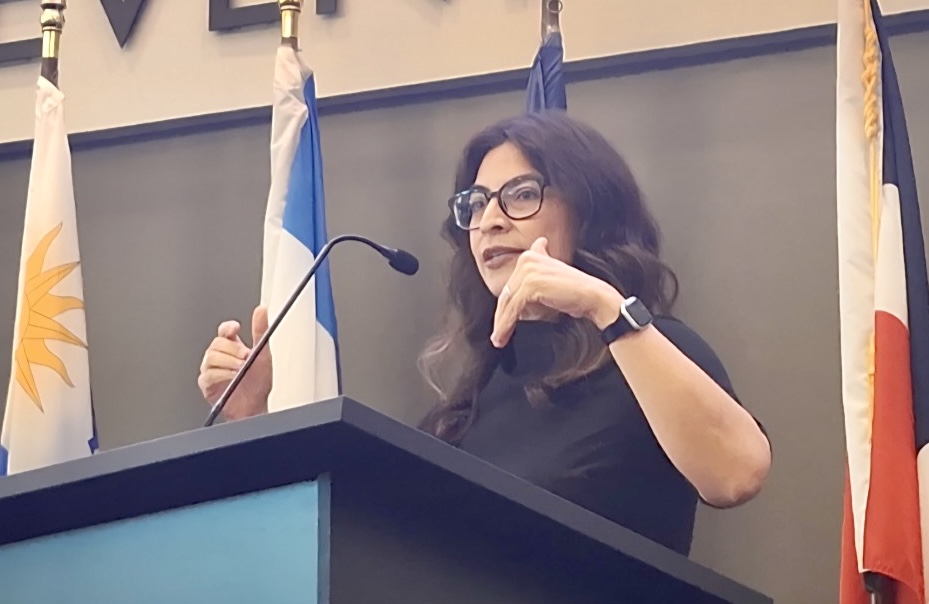
More than three decades after her death, Selena Quintanilla is still shaping how people understand culture, identity and community. The University of the Incarnate Word welcomed Larissa Mercado-López, co-editor of “The Selena Reader: Remembering the Queen of Tejano,” to discuss why her legacy endures.
The book brings together creative and scholarly voices to explore what Selena meant across generations. Her story isn’t just about music. It’s about her memory, belonging and how a community sees itself.

A scholar’s path shaped by Selena
Mercado-López opened her talk by explaining how Selena shaped her own career. She described how Selena influenced her consciousness as a Chicana and shaped her scholarly trajectory.
Mercado-López compared her approach to scholarship to “a hummingbird going from flower to flower,” explaining that her varied interests are connected by a belief that academia needs the voices of Chicanos and marginalized people.
She wanted listeners to consider not only Selena herself, but also what Selena helps people understand about their communities and identities.
“So what I really want you to walk away with today, through both my talk and the conversation after, is not necessarily more understanding of Selena, but of what Selena helps you understand about yourself and your communities because that’s truly what this book is about.”

More than a singer
From there, Mercado-López widened the conversation to the larger subjects that Selena opens up.
“When we talk about Selena, we’re also talking about gender, daughterhood, Latina Womanhood and body politics.”
Mercado-López also discussed capitalism, the history of Tejano music and the place Selena’s songs hold in family and community traditions. As a teenager, she said, Selena inspired her to look for other figures she could admire.
“And as my searches came up empty, I found that it was more fruitful to search for absences, the places where we were not present but where we should be, and in that search, I also sought out belonging.”

A personal connection
For some in the audience, Selena’s legacy is deeply personal. I asked Teofilo Reyes Jr., assistant director of the Ettling Center, about his connection to Selena.
“It’s very nostalgic; it makes me think about my big sisters and me when we were younger”
Reyes, who is originally from Houston and also lived in Corpus Christi, remembered Selena’s final Astrodome concert and the grief his family felt after her death.
Why she still resonates
Selena’s popularity has carried over to younger generations who were not alive when she died. When I interviewed Mercado-López, I wanted to know why people still talk about Selena in Tejano culture today.
Mercado-López pointed to the ways Mexican American families remember loved ones and pass stories from one generation to the next.
“We Mexican Americans do a really good job of remembering our loved ones”
She described memorials, family customs and traditions as ways people keep memories alive. She also pointed to Selena’s continuing commercial presence, from clothing to everyday objects bearing her image.
“You walk into a Hot Topic, and you see a T-shirt with Selena’s face on it.”
“Like do we really need a spoon rest with Selena’s face on it?”
Keeping the story alive
Three decades have passed, and Selena’s story is still being told, from families sharing memories to her music being played at celebrations. For me, passing down memories is familiar. I grew up knowing Selena because of my mom, who played her songs while she cooked. She kept a copy of Joe Nick Patoski’s biography, “Selena: Como la Flor,” which I would take off the shelf and stare at even before I knew how to read. Listening to Mercado-López describe how families keep Selena’s story alive, I realized I’m part of that tradition, too.
