
The first thing I thought about was the story.
On Tuesday morning, in Room 3019 on the third floor of Founders Hall, during my Publications Practicum class, my classmates and I heard sirens outside.
We knew something was happening nearby, but we didn’t know where the emergency vehicles were headed. We certainly didn’t know Founders Hall was involved.
My journalist instinct kicked in.
“Someone grab a press pass. Go get the story,” I said jokingly.
A few minutes later, I saw a UIW Police officer down the hallway directing people to evacuate.
Suddenly, I didn’t have to go looking for the story.
The story had come to Room 3019.
“Let’s go, class. We need to leave.”
One of my classmates, Morgan Huizar, who uses a wheelchair, immediately headed toward the elevators. The rest of us gathered our equipment and belongings and began to leave.
Then the fire alarm sounded.
When we reached the third-floor stairwell, I saw Founders Hall differently than I had before.
The stairs looked narrow. Very narrow.

Not because they had changed, but because so many people suddenly needed them at once.
Students streamed continuously into the stairwell, and for several minutes we waited for an opening where we could safely join the flow.
Students passed us talking with friends, looking at their phones, and, in some cases, wearing headphones. From where I stood, there was no panic. At times, it felt more like classes had been dismissed than a building was being evacuated.
That calm helped keep the evacuation organized. I saw no one running or pushing.
But calm and casual are not the same thing.
An orderly evacuation doesn’t require panic. It does require attention.
When we finally found an opening, my husband helped me into the flow of students.
And then, even in the middle of an evacuation, the journalist in me showed up again.
“Take pictures,” I told him. “Get me pictures.”
At approximately 10:30 a.m., one of those photographs captured students ahead of us descending from the second floor toward the ground level.
Once we entered the stairwell, movement was steady. I saw no visible smoke or flames and smelled no smoke as students continued toward the exits.
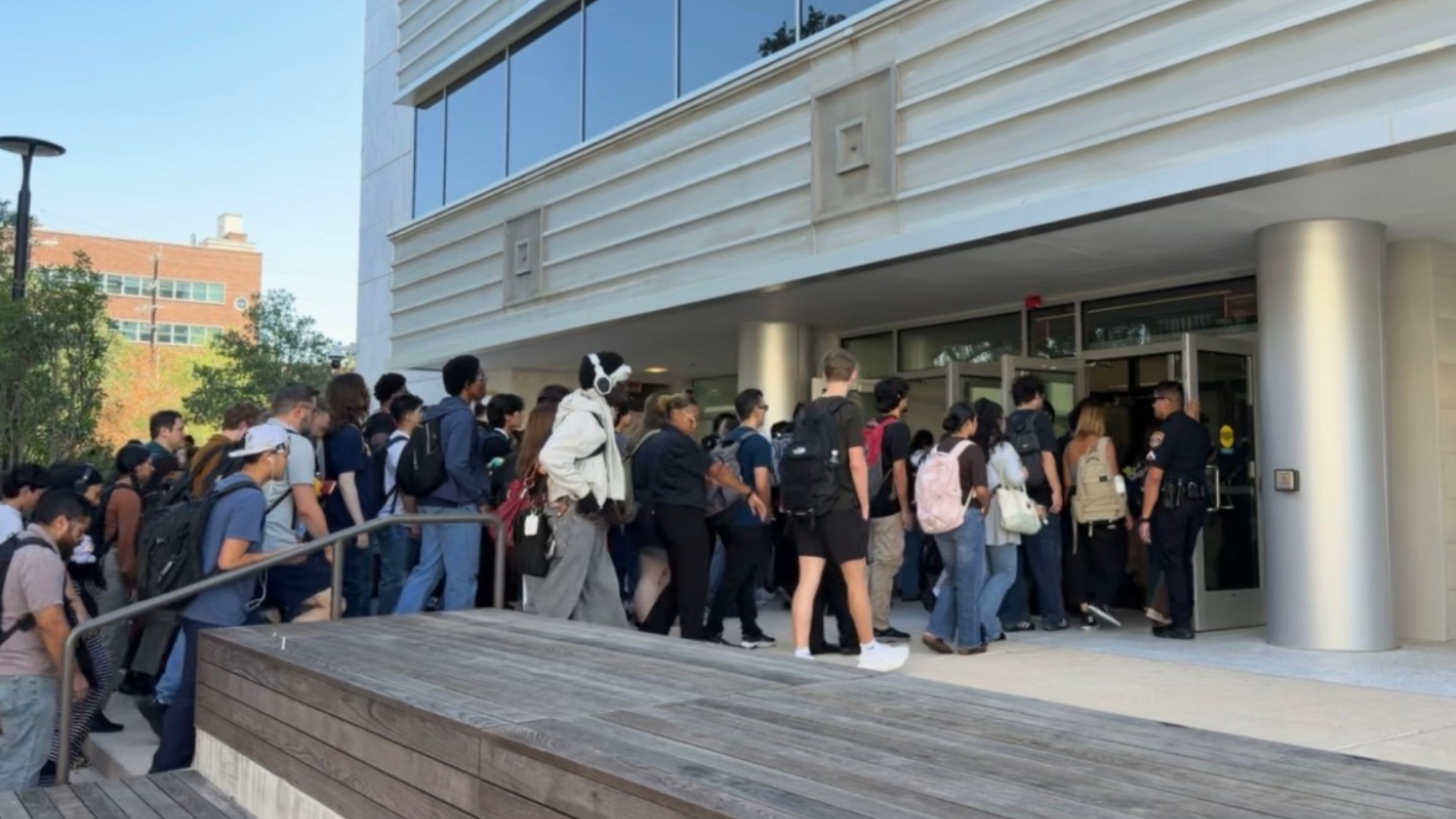
At approximately 10:32 a.m., we were outside.
Police were already moving
One thing stood out throughout the experience: UIW Police were responding before our class even realized Founders Hall was involved.
We first heard sirens outside. A few minutes later, an officer was on the third floor directing occupants to evacuate. By the time we reached the ground level, officers were positioned along the evacuation route and outside the building.
Outside, students stretched along Founders Hall as they waited for authorities to determine when we could return.
Looking at the crowd, I thought about the stairway we had just used.
On an ordinary day, I had never given its width much thought. During an evacuation, with students from across the building moving toward the exits, that same staircase felt completely different.
And another thought was difficult to ignore:
What would that stairwell have looked like if we had seen flames or heavy smoke?
Tuesday’s evacuation remained calm. That was a good thing. Panic, running, or pushing could have created another danger inside an already crowded stairwell.
But experiencing an evacuation — even one that ended safely — made something else clear.
Knowing what to do shouldn’t begin when the alarm sounds.
That became especially apparent when I thought about Huizar.
While most of us could use the stairs, he could not. He needed an accessible evacuation route.
I later heard information about another possible evacuation option for someone unable to use the stairs, but I had not known about it beforehand.
That uncertainty raised a question more important than any particular route:
Would every student know exactly what to do before an emergency?
I didn’t.
Students with mobility limitations need clear instructions about the procedures available to them during an evacuation. So do faculty and staff responsible for helping move classrooms full of people to safety.
Disabilities aren’t always visible. Someone who appears able to walk quickly down several flights of stairs may have a disability or limitation that requires additional time, space, or assistance.
Emergency preparedness has to account for all of them.
As far as the Logos could determine, no injuries resulted from the evacuation.
By approximately 10:34 a.m., students began returning to Founders Hall after authorities gave the all-clear.
The cause of the alarm had not been officially confirmed at the time of this report.
Whatever caused it, the evacuation gave the people inside Founders Hall something valuable: experience.
Students cooperated. UIW Police responded quickly. Fire personnel responded. Occupants exited the building, and students were eventually allowed to return.
That is a good outcome.
The opportunity now is to learn from it.
Students should know their exits before they need them. Faculty should know how to guide their classrooms, and students who cannot use the stairs should know exactly what options are available to them.
Tuesday gave us the opportunity to learn those lessons under the best possible circumstances: police and fire personnel responded, students remained calm, and as far as the Logos could determine, everyone made it out safely.
A few minutes after the all-clear, Founders Hall looked ordinary again. Students returned to class, the hallways filled, and those narrow stairs became just stairs again.
But I don’t think I’ll ever walk down them quite the same way.
